
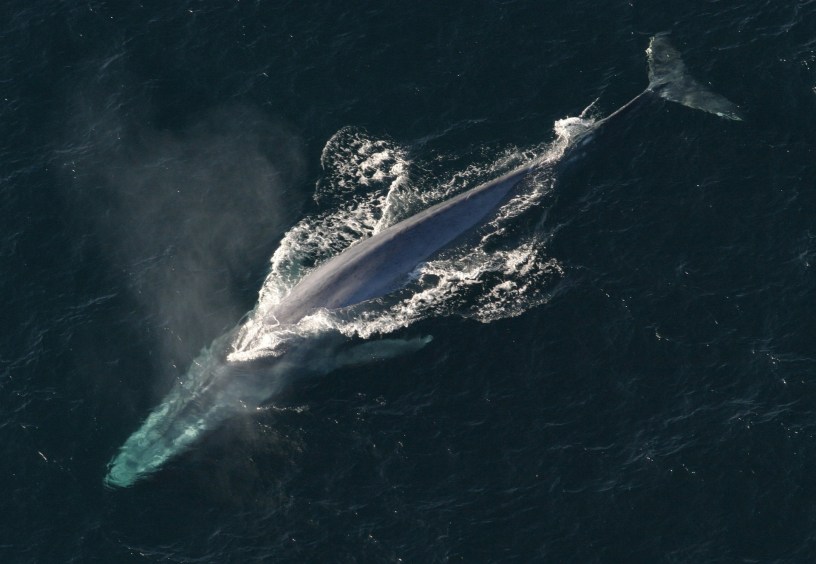
California based marine biologists used suction-cup electrodes to discover the secrets of the blue ‘s whales physiology, as reported last week in Nature.
The blue whale and its massive size has long been a topic of interest for biologists. Its huge body mass needs a large amount of oxygen, but how it provides this during its high-exertion and extremely lengthy feeding dives has been a more specific focus for whale researchers.
A team of researchers, primarily from Stamford, used electrocardiogram electrodes attached to a large, 15 year old male blue whale, with suction-cups being used in order to minimize the impact on the whale itself. Using this method, they were were able to determine that the whale follows a cycle of feeding dives, which can last from a couple of minutes at a depth of a few dozen metres, to massive 16.5 minutes dives at a depth of 184 metres. In between these dives, the whale will rest at the surface for 1-4 minutes.
During the dives, the whales undergo a process called Bradycardia, or slowing of the heart, where their heart rate drops to an average range of 4-8 beats per minute, but can drop as low as 2 bpm. In the rest period when the whale surfaces, the reverse process of Tachycardia takes place, where the heart rates spikes to just under 40 bpm. This is in contrast to the blue whale’s resting heart rate of about 15 bpm.
These figures surprised the researchers, as the diving heart rate was significantly below even their lowest estimate for the whale heart’s beats per minute. The report hypothesizes that these extreme physiological constraints have been the limiting factor the evolutionary size of the blue whale.
You might also like: New Study Shows Remarkable Recovery of Humpback Whale Population
 Scientific Britannicus